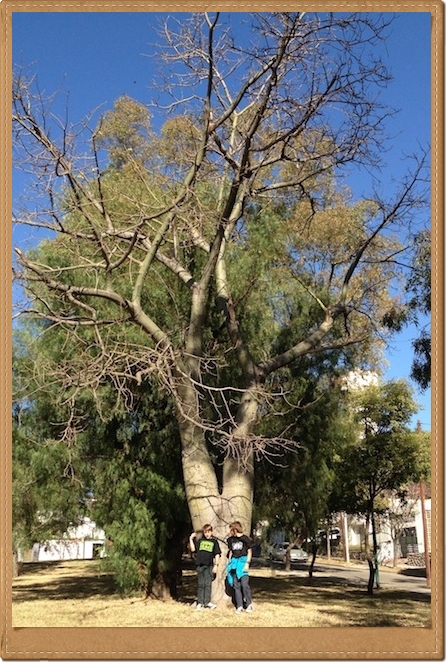
Encounters with a family tree

When I was visiting friends in Cordoba, Argentina recently I came across this tree that looked so much like a baobab that I thought it must be some relation.  When I looked it up, I found it was indeed part of the same family as the Baobab Malvaceae. Its scientific name is Ceiba speciosa commonly known as palo borracho which means “drunken stick” in Spanish.  It is thought that baobabs (before they were baobabs) originated in South America and hence their relations are found here.

The palo borracho occurs in Argentina, Bolivia, Paraguay, Uruguay and Brazil.

Its trunk is bottle shaped, much like the baobab, but with swelling at the bottom of the trunk which makes it look like it may fall over, hence the name.  It never gets as big nor as old as a baobab and is studded with thick thorns along its trunk which store water.  Like the baobab there is chlorophyll just under the bark of the trunk which may allow it to photosynthesize when it does not have leaves.

The fruit and leaves also look like that of baobabs, but the fruit does not have the wonderful nutritious content our trees have.  The palo borracho fruit are filled with masses of fluff that looks like cotton. Meeting it unexpectedly while out exploring was almost as exciting as meeting a far distant member of my own family tree!  

Continue reading....

Find more interesting articles below

Where did that baobab come from?

Where did that baobab come from?

There are 8 different species of Baobab trees 6 of which are native to Madagascar, one in Africa and one in Australia. There’s a lot of controversy about where the Baobab tree originated  as it’s often been assumed that Madagascar is the centre of origin because it has the most different species. This implies that […]

Read more
2015 May: EcoProducts Foundation: creating a culture of caring

2015 May: EcoProducts Foundation: creating a culture of caring

I decided to create the EcoProducts Foundation (a non-profit organisation) when I realised that simply providing employment to local Venda communities wasn’t enough.  I wanted to do more and decided to support early childhood development, which in these rural areas is very neglected.   In addition, the results of my PhD research revealed that goats and drought were hampering the growth […]

Read more
Baobab Flower research in Ghana

Baobab Flower research in Ghana

In August last year Dr Sarah Venter visited Ghana to see if there are any significant variations between the North-West African baobabs versus our Southern African Baobabs. “The journey took me from Accra, the capital on the Atlantic coast of West Africa about 800km right up to the northern-most part of the country.  Here Baobab […]

Read more