Encounters with a family tree

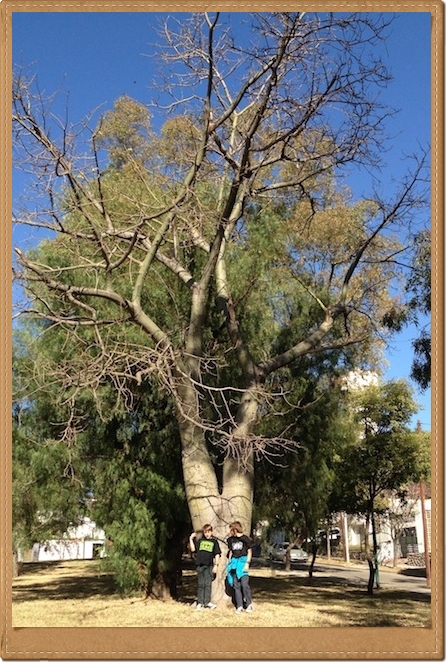
When I was visiting friends in Cordoba, Argentina recently I came across this tree that looked so much like a baobab that I thought it must be some relation.  When I looked it up, I found it was indeed part of the same family as the Baobab Malvaceae. Its scientific name is Ceiba speciosa commonly known as palo borracho which means “drunken stick” in Spanish.  It is thought that baobabs (before they were baobabs) originated in South America and hence their relations are found here.

The palo borracho occurs in Argentina, Bolivia, Paraguay, Uruguay and Brazil.

Its trunk is bottle shaped, much like the baobab, but with swelling at the bottom of the trunk which makes it look like it may fall over, hence the name.  It never gets as big nor as old as a baobab and is studded with thick thorns along its trunk which store water.  Like the baobab there is chlorophyll just under the bark of the trunk which may allow it to photosynthesize when it does not have leaves.

The fruit and leaves also look like that of baobabs, but the fruit does not have the wonderful nutritious content our trees have.  The palo borracho fruit are filled with masses of fluff that looks like cotton. Meeting it unexpectedly while out exploring was almost as exciting as meeting a far distant member of my own family tree!  

Continue reading....

Find more interesting articles below

Miss Earth SA 2014 finalists meet the Baobab

Miss Earth SA 2014 finalists meet the Baobab

Yesterday the Miss Earth SA 2014 finalists met the Baobab. Sarah Venter gave them a talk on the baobab tree and EcoProducts and came away completely charmed and delighted by this impressive group of committed down-to-earth eco-princesses. Here are finalists Steffani Alexander & Roxanne Watson with baobab oil and other pics taken from the session.  And today is […]

Read more
2014 Jun: Coppicing Baobabs

2014 Jun: Coppicing Baobabs

When baobabs are still young they are vulnerable to damage.  This young baobab was damaged at the base, but it was helped to survive by coppicing (sprouting).  After a few years most of the coppice shoots die but two or three remain leaving the tree to develop into a multistemed tree which you can clearly see in […]

Read more
Miss Earth SA and EcoProducts – Green Queens all!

Miss Earth SA and EcoProducts – Green Queens all!

We're so excited about our collaboration with Miss Earth SA!  There's so much synergy between our two organisations and we're thrilled that they are endorsing EcoProducts Baobab oil.  We love their combination of beauty and eco-savvy as well as their amazing leadership program which serves to encourage and empower young women into leadership positions as nurturing stewards of our beautiful earth. […]

Read more